Understanding the nuances between pad-mounted and prefabricated substations is essential for energy professionals. According to Dr. Emily Richards, an expert in electrical engineering, "The choice between pad-mounted and prefabricated solutions heavily impacts efficiency and installation." This raises an important question: what is the difference between pad-mounted and prefabricated substations?
Pad-mounted substations are often used in residential areas. They are compact and installed directly on concrete pads. Their design allows for easy access and maintenance. However, they may have limitations in terms of capacity and flexibility.
In contrast, prefabricated substations offer modular designs. These units can be customized to meet specific needs. They are typically factory-built and transported to site ready for installation. While they require more upfront planning, their scalability can lead to better long-term solutions. By exploring these distinctions, we gain vital insights into optimizing energy distribution systems.
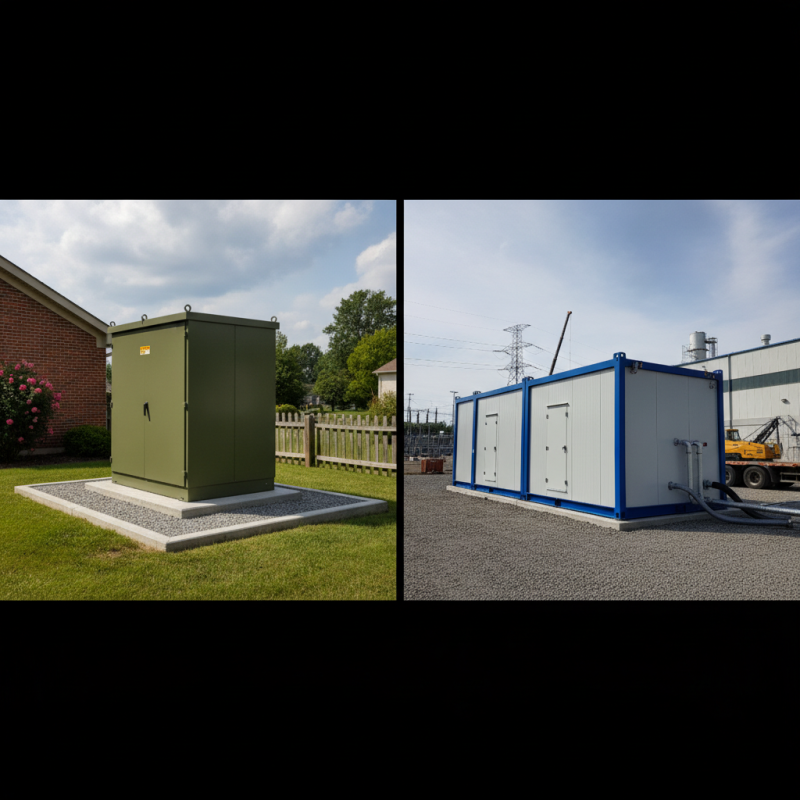
Pad mounted and prefabricated substations serve unique functions in power distribution. Their design differences significantly impact their applications. A pad mounted substation is typically smaller and designed for specific site requirements. It is frequently used in residential or commercial areas. The compact design can fit within a limited footprint, which minimizes the installation impact on the surroundings.
In contrast, a prefabricated substation offers modularity and flexibility. These units can be customized for larger power demands. They are often equipped with advanced technology to manage distribution effectively. According to industry reports, prefabricated substations can reduce installation time by up to 30% compared to traditional designs. They are ideal for rapidly growing urban areas requiring quick energy solutions.
Tips: When choosing between these options, consider site size, future expansion needs, and local regulations. Accurate spatial planning can avoid future regrets. Also, evaluate your long-term energy goals carefully. A well-considered approach may save costs down the line. Adapting to changing needs can enhance the value of your investment.
| Feature | Pad Mounted Substations | Prefabricated Substations |
|---|---|---|
| Installation Location | Typically installed on concrete pads | Can be installed in various locations, including rooftops |
| Structure | Box-like structure, often visible above ground | Modular design, can be skidded onto site |
| Footprint | Generally larger footprint due to construction | Compact footprint, designed for limited space |
| Cost | Typically lower installation costs | Higher initial cost due to prefabrication |
| Maintenance | Easier access for maintenance | May require specialized access for maintenance |
| Environmental Resistance | Designed to withstand outdoor conditions | Often weather-resistant, built for various climates |
Pad-mounted substations are essential in electrical distribution. Their design is particularly suited for urban areas. These substations provide a safe, compact way to distribute power. They usually contain transformers and switchgear. Their compact nature makes them easier to install and maintain.
Key components of pad-mounted substations include transformers, fuses, and circuit breakers. Transformers reduce high-voltage electricity for safe distribution. Fuses protect the system from overloads and faults. Circuit breakers allow for quick isolation during maintenance or emergencies. These components work together to ensure the reliability of the power supply.
Despite their benefits, there are challenges. Space limitations can restrict the size and arrangement of components. Personnel must be trained to manage these assets properly. Regular maintenance is also critical to avoid failures. All these aspects highlight the need for careful planning and execution.
This chart illustrates the key components and differences between Pad Mounted and Prefabricated Substations, highlighting their respective capacities and applications.
Prefabricated substations are gaining traction in the energy sector. They are factory-built, ensuring faster deployment. Key components of these stations include switchgear, transformers, and control systems. Each plays a crucial role in the efficiency of power distribution.
Switchgear serves as the backbone of prefabricated substations. It ensures safe operation by controlling and protecting electrical equipment. A recent industry report highlights that effective switchgear design can reduce operational costs by up to 20%. This integration of technology streamlines maintenance and enhances reliability.
Transformers are essential as they adjust voltage levels for transmission. A well-designed transformer can improve energy efficiency by at least 10%, according to energy studies. Control systems, another component, monitor power flow and diagnose potential issues. The synergy between these parts results in robust and dependable power solutions. Prefabricated substations not only offer resilience but also an adaptable layout. As the industry evolves, continuous learning and improvement in designs will be necessary to meet future demands.
Pad mounted substations serve various applications in today's electrical distribution landscape. They are commonly installed in urban areas where space is limited. These substations are compact and offer an effective way to manage power distribution. According to the U.S. Department of Energy, the demand for pad mounted substations is expected to rise by 30% over the next decade as cities expand and modernization efforts increase.
Many utilities choose pad mounted substations for their flexibility. They can be integrated into existing infrastructure without major construction disruption. This method not only improves efficiency but also can reduce costs. However, challenges exist. For instance, their outdoor placement can expose them to environmental factors, which could affect longevity. Regular maintenance is essential to mitigate these risks. A study by the Electrical Power Research Institute suggests that maintaining older installations can yield significant cost benefits over time.
Additionally, pad mounted substations are increasingly used in renewable energy applications. They facilitate the connection of solar panel farms and wind turbines to the grid. This transition to greener energy sources is gaining momentum. Data shows that integrating these technologies can reduce carbon emissions significantly. However, the planning process must consider local regulations and site conditions. Each installation presents unique challenges that require tailored solutions.
Prefabricated substations are increasingly popular in various sectors. They provide a flexible solution for power distribution. According to a report by the International Energy Agency, investing in prefabricated technology could reduce installation time by up to 30%. This time-saving can be critical in projects where deadlines are tight.
These substations are particularly advantageous in urban environments. They occupy less space compared to traditional setups. This is vital in densely populated areas, where space is at a premium. The modular design allows easy transportation and assembly, making them ideal for quick deployment in emergencies or temporary setups.
However, not all projects benefit equally from prefabricated substations. Some configurations may face challenges during installation. Site-specific conditions can complicate deployment. Engineers must consider local regulations and environmental factors, which can impact efficiency. Despite these challenges, the trend towards prefabricated solutions continues to grow, driven by the need for rapid, reliable power distribution.
: They manage power distribution, especially in urban areas with limited space.
Urban expansion and modernization efforts are driving a 30% increase in demand over the next decade.
They integrate easily into existing infrastructure without major construction disruption.
Regular maintenance is crucial to address environmental exposure that could impact longevity.
They reduce installation time by up to 30%, helpful in tight project deadlines.
Site-specific conditions and local regulations can complicate their deployment.
Yes, their modular design allows for quick transportation and assembly in urgent situations.
Pad mounted substations connect renewable sources like solar panels and wind turbines to the grid.
Some configurations could encounter installation challenges due to varying site conditions.
Exposure to environmental factors may lead to premature wear if not properly maintained.
This article explores what is the difference between pad-mounted and prefabricated substations, focusing on various aspects such as design, components, and applications. Pad-mounted substations are typically designed for low to medium voltage applications and feature a compact design suitable for urban areas. Key components include transformers, switchgear, and protective devices, all housed in a enclosed unit for safety and accessibility.
In contrast, prefabricated substations are designed for larger capacities, making them ideal for extensive networks such as industrial sites or utility applications. They are assembled off-site and come with all necessary components, including buses, transformers, and control systems. Each type serves distinct purposes: pad-mounted substations are often used in residential settings and commercial areas, while prefabricated substations cater to larger infrastructure needs, ensuring efficient power distribution and reliability.

Zeno Electric