China Top How to Design Centralized Energy Storage Cooling?

Time:2026-09-22 Author:Isabella
0%

China’s centralized energy storage market is expanding quickly, but cooling design remains a practical engineering challenge. The International Energy Agency reported that global battery storage additions nearly doubled in 2023, reaching about 42 GW. China contributed a major share of this growth. More containers mean greater thermal-management responsibility.

This is the real question: how to design a cooling system for centralized energy storage without sacrificing safety, efficiency, or service life. The U.S. Department of Energy’s Energy Storage Grand Challenge Roadmap identifies thermal management as essential to battery performance and safety. UL 9540A testing and NFPA 855 requirements also show that cooling cannot be separated from fire-risk assessment. A practical design begins with cell chemistry, rack layout, enclosure volume, local climate, and expected operating cycles.

David Howey, Professor of Engineering at the University of Oxford, has stated, “Temperature is one of the most important factors affecting battery performance and lifetime.” His point is simple. A few degrees matter. Uneven temperatures matter more.

In a Chinese outdoor cabinet, summer conditions can exceed 40°C. Dust may block filters. Partial loading can create uneven airflow. Liquid cooling may improve heat transfer, yet it adds pumps, valves, leak controls, and maintenance demands. Air cooling is simpler, but it may struggle with high-density racks.

There is no universal answer. That is the uncomfortable part. Designers should compare CFD results, seasonal load profiles, auxiliary power, and failure scenarios before selecting equipment. Reports from the China Energy Storage Alliance and the National Renewable Energy Laboratory provide useful benchmarks, but field measurements still deserve greater weight. A successful system is not merely cold. It is predictable, serviceable, and verifiably safe.
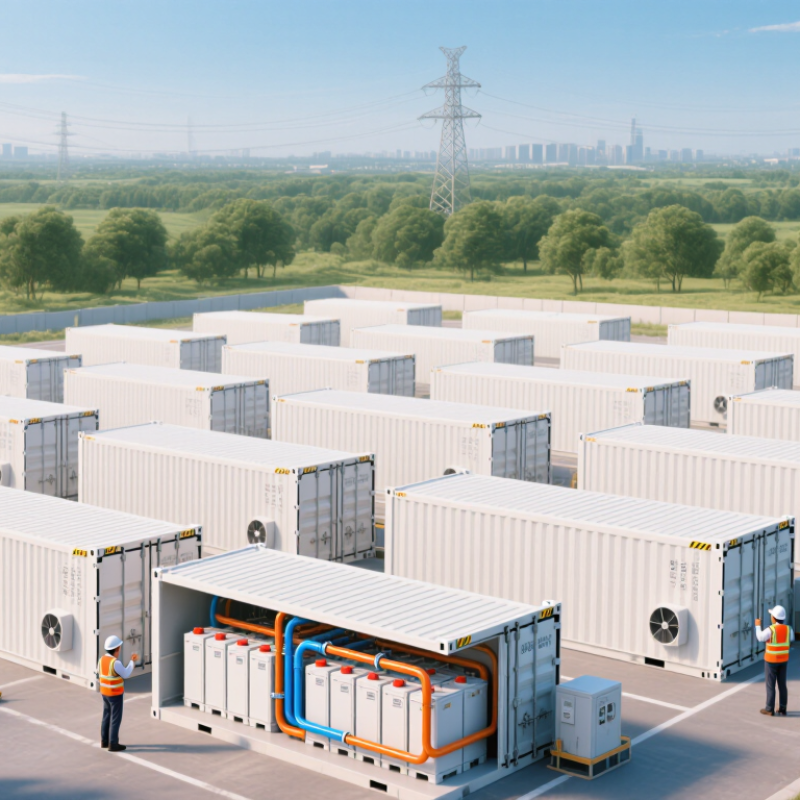
China Top How to Design Centralized Energy Storage Cooling?

Centralized Energy Storage Cooling: Purpose and System Requirements

Centralized Energy Storage Cooling: Purpose and System Requirements

A centralized cooling system does more than remove heat. It protects battery performance, operating safety, and usable service life. In a large storage room, dozens of battery racks release heat unevenly during charging and discharging. A single warm corner can develop near a blocked aisle or crowded cabinet.

The design should begin with a measured heat-load calculation. It must include battery losses, inverters, lighting, ventilation, and local climate conditions. Temperature control should remain stable, often within the battery manufacturer’s specified range. Humidity control also matters, because condensation can damage electrical connections. Airflow needs careful balancing across racks. Poor circulation creates hidden hot spots.

Reliability requires redundancy. An N+1 cooling arrangement can maintain operation when one unit fails or receives maintenance. Each unit should connect with the battery management and energy management systems. Important alarms include high temperature, fan failure, filter blockage, refrigerant problems, and water leakage. Fire detection and emergency ventilation must work independently from normal cooling controls. Clear access for inspection is essential.

Practical commissioning should include thermal mapping under different loads. Record temperatures at rack fronts, rear aisles, and ceiling level. The results may challenge the original simulation. No design is perfect. A neglected cable opening or dirty filter can reduce real performance quickly. Scheduled maintenance, spare components, and documented response procedures make the cooling system more dependable over time.

Assessing Thermal Loads and Environmental Conditions in China

China Top How to Design Centralized Energy Storage Cooling?

Centralized energy storage cooling starts with a realistic thermal-load assessment. Battery heat comes from charging, discharging, resistance, and auxiliary equipment. Peak loads often appear during hot afternoons and repeated grid-support cycles. A simple average temperature is convenient, but it can mislead.

Use measured operating data, cell efficiency, enclosure size, and expected cycling frequency. In northern China, winter heating and cold-start behavior matter. In southern regions, high humidity increases condensation risks. Plateau sites also face strong solar radiation and thinner air.

Environmental conditions should guide the cooling architecture. Outdoor containers may experience dust, rain, salt air, or sudden temperature changes. Coastal projects need stronger corrosion control. Inland sites may require better filtration during dry seasons.

Keep airflow paths clear, and separate hot exhaust air from fresh intake air. Field inspections often reveal blocked filters and uneven temperatures. These problems seem minor. They are not.

Sensors should track temperature, humidity, pressure, and airflow across different zones. Alarm limits must reflect battery safety requirements and local climate records.

Tips: Build a seasonal thermal model before selecting cooling equipment. Test the hottest design day, not only the annual average. Leave service space around filters, fans, and heat exchangers. Review the design after the first summer. Real operating data may expose assumptions that looked reasonable on paper.

Selecting Cooling Technologies for Centralized Energy Storage Facilities

Selecting Cooling Technologies for Centralized Energy Storage Facilities

Centralized battery storage is scaling quickly. The IEA reported nearly 42 GW of utility-scale battery additions in 2023, over double the previous year. Greater density increases thermal management pressure. Cooling selection should begin with climate, rack spacing, charge rates, and maintenance access. Not with equipment cost alone.

Air cooling remains practical for moderate-density facilities. It uses familiar components and avoids coolant leaks. However, hot spots may develop near tightly packed modules, especially during summer charging. Liquid cooling offers more uniform heat removal and can reduce temperature differences between cells. It also requires pumps, filtration, leak detection, and emergency isolation. Immersion systems can improve thermal control, but their fluid compatibility and service procedures deserve careful validation.

Use measured operating data, not assumptions. The U.S. Department of Energy highlights thermal safety, efficiency, and lifecycle cost as core storage design considerations. NFPA 855 and UL 9540A testing provide important guidance for installation and thermal runaway evaluation. During commissioning, engineers should record inlet temperature, cell temperature spread, fan or pump power, and alarm response. A neat spreadsheet is not enough. Dust, blocked filters, unexpected humidity, and partial-load operation can change results. Cooling capacity should also cover degraded batteries, not only new modules. The uncomfortable question is simple: what happens when one cooling circuit stops on the hottest afternoon?

China Top How to Design Centralized Energy Storage Cooling? - Selecting Cooling Technologies for Centralized Energy Storage Facilities

Cooling Technology Typical Application Scale Typical Battery Temperature Control Approximate Cooling Energy Use Water Consumption Maintenance Requirement Main Advantages Main Limitations Recommended Design Conditions
Direct-Expansion Air Cooling Small to medium centralized facilities; commonly used for containerized systems Usually designed to maintain approximately 15–30°C around the battery racks Generally moderate; seasonal performance depends strongly on outdoor temperature and part-load operation Low during normal operation; condensate drainage may be required Moderate; filters, fans, compressors, refrigerant circuits and condensate paths require inspection Simple layout, relatively low initial complexity, fast installation and easy modular deployment Air distribution can be uneven in high-density racks; efficiency decreases in very hot climates Suitable where installation speed, modularity and low water availability are important
Central Chilled-Water Cooling Medium to very large facilities with multiple battery rooms or containers Typically supports stable room or liquid-loop control in the approximate range of 18–28°C Often efficient at high load and large scale; central plant performance is commonly evaluated using COP and part-load efficiency Low with air-cooled chillers; potentially moderate to high with cooling towers or evaporative condensers Moderate to high; requires pumps, chillers, valves, water treatment and leak monitoring Good scalability, centralized monitoring, effective heat rejection and strong redundancy options Higher capital cost, larger plant footprint and greater consequences if the central loop fails Preferred for large campuses where centralized utilities, redundancy and professional maintenance are available
Cold-Plate Liquid Cooling Medium to large, high-power-density battery systems Commonly designed for tighter cell-to-cell temperature uniformity, often within approximately 3–5°C across a module when properly engineered Usually lower fan power than full air cooling; pump and chiller power must be included in the system calculation Very low in a sealed loop; periodic fluid replacement and leak testing may be necessary High technical control requirement; pumps, heat exchangers, hoses, manifolds and fluid quality require monitoring High heat-transfer capability, compact design and improved temperature uniformity for fast-charge or high-C-rate operation More components, potential leak risk and higher integration complexity than air cooling Recommended for high-power applications, compact layouts and systems requiring precise thermal management
Immersion Liquid Cooling High-density, high-power or specialized large-scale energy storage installations Can provide highly uniform thermal conditions when the dielectric fluid circulation system is correctly sized Potentially low auxiliary fan energy; pump, heat-exchanger and fluid-management energy must be assessed Very low during normal operation because the working fluid is recirculated High; fluid condition, seals, pumps, filtration, compatibility and service procedures require specialist management Excellent heat transfer, high packaging density and reduced dependence on internal air circulation Higher fluid and enclosure cost, more complex maintenance and additional safety assessment for fluid compatibility Consider for demanding high-density projects where thermal uniformity and footprint are more important than simplicity
Evaporative-Assisted Cooling Medium to large facilities in hot, dry or semi-arid climates Can maintain suitable battery-room conditions when outdoor wet-bulb temperature is favorable and humidity is controlled Often reduces compressor energy in suitable weather; performance decreases as humidity and wet-bulb temperature rise Moderate to high; depends on climate, set points, cycles of concentration and water-treatment strategy Moderate to high; requires water treatment, drift control, hygiene management and regular cleaning Can reduce peak electrical demand and compressor runtime in dry climates Water dependency, mineral scaling, humidity concerns and reduced benefit in humid climates Use only where water supply, water quality and local climate conditions support reliable operation
Hybrid Air-Liquid Cooling Large facilities with mixed rack densities, phased expansion or varying operating profiles Provides room-level control for general loads and liquid-loop control for high-heat-density modules Can reduce total auxiliary energy by matching the cooling method to the actual heat load Usually low; water use depends on whether the heat-rejection system uses evaporative equipment High; requires coordinated control of air handlers, pumps, valves, heat exchangers and monitoring systems Flexible, scalable and suitable for facilities with different battery chemistries or power densities More complicated controls, commissioning and fault diagnosis than a single cooling method Best for future-ready facilities where load diversity and staged capacity growth are expected
Design Note: The values and ratings above are typical engineering ranges and qualitative comparisons rather than guarantees. Final selection should be based on battery chemistry, rack energy density, charge and discharge profile, ambient temperature, humidity, fire-safety strategy, water availability, redundancy requirements and the total life-cycle cost of the facility.

Designing Airflow, Piping, Controls, and Safety Protection

Centralized energy storage cooling begins with airflow, not equipment selection. In containerized rooms, hot exhaust zones can form above densely packed racks. Place supply paths low and return paths high. Avoid direct short-circuiting between outlets and inlets. Leave service clearance around filters, fans, and battery enclosures. Install sensors at rack faces, ceiling level, and return ducts. A small airflow imbalance can hide a dangerous hot spot. Field testing matters. Measure temperature and velocity during charging, discharging, and fault conditions.

Cooling piping should follow short, accessible routes with isolation valves at critical sections. Where liquid cooling is used, size pumps for pressure loss, elevation, and future expansion. Install leak detection beneath joints, manifolds, and flexible connections. Protect pipes from vibration and accidental impact. Keep water lines away from electrical cabinets when practical. Insulation must resist condensation in humid environments. Poor drainage remains a common weakness.

Controls should connect temperature, pressure, flow, smoke, gas, and door signals. Alarm levels need clear actions, not confusing messages. A high-temperature alarm may trigger staged cooling, load reduction, or controlled shutdown. Safety protection must follow applicable fire, electrical, and building requirements. Coordinate cooling shutdown with emergency ventilation and fire systems. Provide manual emergency stops and a supervised reset process. No layout is perfect. During commissioning, real measurements may challenge the design assumptions. Maintenance records often reveal problems that drawings miss.

Testing, Monitoring, and Optimizing Cooling System Performance

A centralized energy storage cooling system needs more than a low temperature reading. Testing should begin with sensors placed at container inlets, outlets, battery racks, and exhaust paths. Engineers can record temperature, humidity, coolant flow, pressure, and power consumption at five-minute intervals. Thermal imaging may reveal a hot corner that ordinary sensors miss. Keep test conditions consistent, including battery load, outdoor temperature, and ventilation status. Small differences matter.

Monitoring should connect live data with clear operating limits. A sudden 3°C rise between neighboring racks may indicate blocked airflow, uneven loading, or a failing fan. Alarm settings require practical delays, because instant alerts can create unnecessary responses. However, excessive delays can hide a developing fault. Sensor calibration must follow a documented schedule, with independent checks during maintenance. A neat dashboard can still mislead.

Optimization comes from comparing cooling output with energy use. Adjust fan speed, coolant flow, and control timing according to real load patterns rather than fixed assumptions. Nighttime testing may expose unnecessary cooling demand. Field teams should also inspect filters, cable routes, drain lines, and insulation by hand. Our early models may look efficient, yet field measurements can disagree. That gap deserves investigation, not concealment. Record every adjustment, including failed trials, so later decisions rely on evidence rather than memory.

FAQS

What is the main purpose of centralized energy storage cooling?

It removes heat and protects battery performance, operating safety, and service life. A warm corner can still cause trouble.

How should the cooling load be calculated?

Include battery losses, inverters, lighting, ventilation, local climate, and expected charging cycles. A simple average temperature may mislead. Test the hottest design day.

Why are airflow patterns important in battery storage rooms?

Uneven airflow can create hidden hot spots near crowded racks or blocked aisles. Place supply paths low and return paths high. Measure airflow during real operating conditions.

Which environmental conditions need special attention?

Humidity, dust, salt air, rain, solar radiation, and sudden temperature changes affect system performance. Coastal sites need corrosion protection. Dry regions may need stronger filtration.

What sensors should a centralized cooling system include?

Monitor temperature, humidity, pressure, airflow, smoke, gas, water leakage, and door status. Place sensors at rack faces, ceiling level, and return ducts. Sensor coverage is never perfect.

Why is redundancy useful in cooling design?

An N+1 arrangement can maintain cooling when one unit fails or needs maintenance. Keep spare components available. A single failure should not threaten the whole room.

What safety alarms and controls are recommended?

Use alarms for high temperature, fan failure, blocked filters, refrigerant issues, and water leakage. High-temperature alarms may trigger staged cooling, load reduction, or controlled shutdown. The alarm must explain the action.

How should cooling systems be commissioned after installation?

Create thermal maps during charging, discharging, and fault conditions. Record temperatures at rack fronts, rear aisles, and ceiling level. Real measurements may challenge the simulation.

What maintenance practices improve long-term reliability?

Inspect filters, fans, pipes, drains, sensors, and leak detection devices regularly. Keep access clear around heat exchangers and electrical cabinets. A dirty filter can reduce performance quickly.

Conclusion

Designing centralized energy storage cooling requires a clear understanding of thermal control, operational reliability, and site conditions. This article explains how to design a cooling system for centralized energy storage by first identifying heat sources from batteries, power conversion equipment, and auxiliary systems. It also considers China’s regional climate differences, including high summer temperatures, humidity, dust, and temperature fluctuations, to establish suitable design parameters. Accurate thermal-load assessment helps determine cooling capacity, redundancy, ventilation needs, and energy-efficiency targets.

The discussion then compares practical cooling approaches and explains how to coordinate airflow paths, piping networks, sensors, control logic, and safety protection. Proper zoning and uniform temperature distribution can reduce battery performance differences and improve system life. Finally, the article covers commissioning, performance testing, continuous monitoring, alarm management, and operational optimization. A well-designed system should maintain stable temperature and humidity, respond quickly to abnormal conditions, simplify maintenance, and remain reliable under changing loads and environmental conditions.

Isabella

Isabella

Isabella is a dedicated marketing professional with a sharp focus on driving brand growth and engagement through strategic content creation. With an extensive background in digital marketing, she combines her passion for storytelling with her keen understanding of industry trends to deliver......